Program examples
Smaller orchestras (up to 65 musicians)
''Masks and Memory''
Kabalevsky - Colas Breugnon Overture
Khachaturian - Masquerade Suite
Enescu - Romanian Rhapsody no.1
An evening of color, disguise, and folk spirit from Eastern Europe's stage and countryside. Kabalevsky opens with the mischievous energy of Colas Breugnon. Khachaturian's Masquerade Suite follows — glittering, theatrical, and unmistakably danceable. Enescu closes with his Romanian Rhapsody No. 1, a joyous eruption of folk melody that brings the whole evening to its feet. A light program suitable for first time concert goers possibly without break. Ca. 55 piece orchestra.
''Forgotten Symphony''
Weber - Oberon Overture
Mendelssohn - Violin Concerto in E minor
Kalinnikov - Symphony No. 1
Weber's Oberon opens with a horn call in the fairy wood, written in London while he was dying, and finished only weeks before his death. Mendelssohn then does something no one had done with the violin concerto: he skips the orchestral introduction entirely, hands the soloist the tune in the second bar, and never lets the piece stop until it ends. It became one of the most beloved concertos ever written, and it has not lost an ounce of its charm.After the interval, a symphony you almost certainly have not heard. Vasily Kalinnikov wrote his First in 1895, poor and ill, with Tchaikovsky's support behind him. He died at 34. What he left is thirty-five minutes of melody so generous that audiences at the premiere demanded the finale again. It deserves to be far better known.
''Femmes en lumière" - female composers in spotlight
Bacewicz – Overture (1943)
Schumann – Piano Concerto
Beach – "Gaelic" Symphony
Three composers, brought into the light. Grażyna Bacewicz opens with her 1943 Overture, composed in secret during the Nazi occupation of Poland — its timpani beating out the Morse code for "V," victory encoded in sound. Clara Schumann's Piano Concerto in A minor, written in her teens, reveals the brilliance of a pianist celebrated across 19th-century Europe — long before history remembered her chiefly as "Robert's wife." Amy Beach closes the evening with her "Gaelic" Symphony, the first symphony published by an American woman — Irish folk melody woven into a lush, fully Romantic canvas. Three voices, three centuries of near-invisibility, finally given the stage. Ca. 65 piece orchestra.
"Echoes and Inheritance" - female composers in spotlight
Lili Boulanger – D'un matin de printemps
Sofia Gubaidulina – Fairytale Poem
Louise Farrenc – Symphony No. 3 in G minor
Three legacies nearly lost to time. Lili Boulanger opens with D'un matin de printemps, one of her final works before her death at 24 — luminous, restless, and impressionist in color, hinting at everything she might still have written. Sofia Gubaidulina's Fairytale Poem, composed in her twenties in the Soviet Union, unfolds like a piece of spoken narrative turned to orchestral color — vivid, imaginative, and already unmistakably her own voice. Louise Farrenc closes with her Symphony No. 3 — rigorously constructed, warmly Romantic, and among the finest French symphonies of her century, despite decades of near-total neglect. Three inheritances, each denied their full hearing in their own time — passed forward here, finally, in full voice.
Larger orchestras (above 65 musicians)
''Voices of Resistance'' - Ukrainian composer
Sibelius - Finlandia
Shostakovich - Cello Concerto no.1
Boris Lyatoshynsky Symphony No. 3 “Peace will defeat war”
Sibelius opens with Finlandia, composed under Russian imperial censorship as a coded declaration of Finnish national identity — resistance disguised as pure orchestral sound. Shostakovich's Cello Concerto No. 1 follows: taut, personal, and unflinching, a solo voice pressing against the full weight of the orchestra behind it. The program closes with Boris Lyatoshynsky's Symphony No. 3, "Peace will Defeat War" — a work the composer was forced to revise under Soviet pressure after its 1951 premiere, its very existence a testament to Ukrainian musical identity surviving political interference. Written in the shadow of war and censorship alike, it carries both grief and an unyielding conviction that peace endures. Together, three voices from three nations answer the same pressure the same way: not with silence, but with sound. ca. 75 piece orchestra.
''Searching For Home''
Ives - The Unanswered Question
Dawson - Negro Folk Symphony
Dvorak - Symphony no.9
Three composers exploring the themes of home and identity. New voices in the American classical music scene. Grappling with home, nostalgia, and identity. ca. 85 piece orchestra.
''One Body, Many Voices''
Fiumara - Here Comes Everybody
Massanet - Meditation
Rachmaninoff - Symphonic Dances
Anthony Fiumara composed Here Comes Everybody dreaming of an orchestra as one vast, sounding body — a hundred voices moving as a single storm. That image opens the program: relentless, communal, unstoppable. Massenet's Méditation pulls back to a single voice — one violin, suspended in stillness, speaking where the full orchestra falls silent. Rachmaninoff closes with his Symphonic Dances, his final completed work — the many voices return, driving toward one last, unresolved dance.
Together, three works trace a single arc: from the many, to the one, and back again. Ca. 85 piece orchestra.
''Tales of the East''
Fazil Say - Grand Bazaar
Prokofiev - Scynthian Suite
Khachaturian - Gayane Suite
A journey eastward across three landscapes. Fazıl Say's Grand Bazaar — by a living Turkish composer — throws us straight into the noise, colour and rhythm of an Istanbul market, Western orchestra evoking Turkish drums and the ney flute. Prokofiev's Scythian Suite carries us out onto the ancient steppe, all sun and savagery. Khachaturian's Gayane — Armenian, Soviet, irresistibly rhythmic — brings us to the village: the famous Sabre Dance, but also the aching Adagio and the folk dances that are rarely heard in full. The arc moves from city to wilderness to community, three composers from three points along the old Silk Road that connected my part of the world to Europe. Ca. 100 piece orchestra.
For more immersive project examples with more details please visit special projects.
If you'd like more program ideas that would fit your particular needs (themes, setting, duration, format) please feel free to contact me directly. There are various compositions with possibilities for national premieres from eastern voices and Dutch composer that I would be glad to discuss.
Conductor's bio
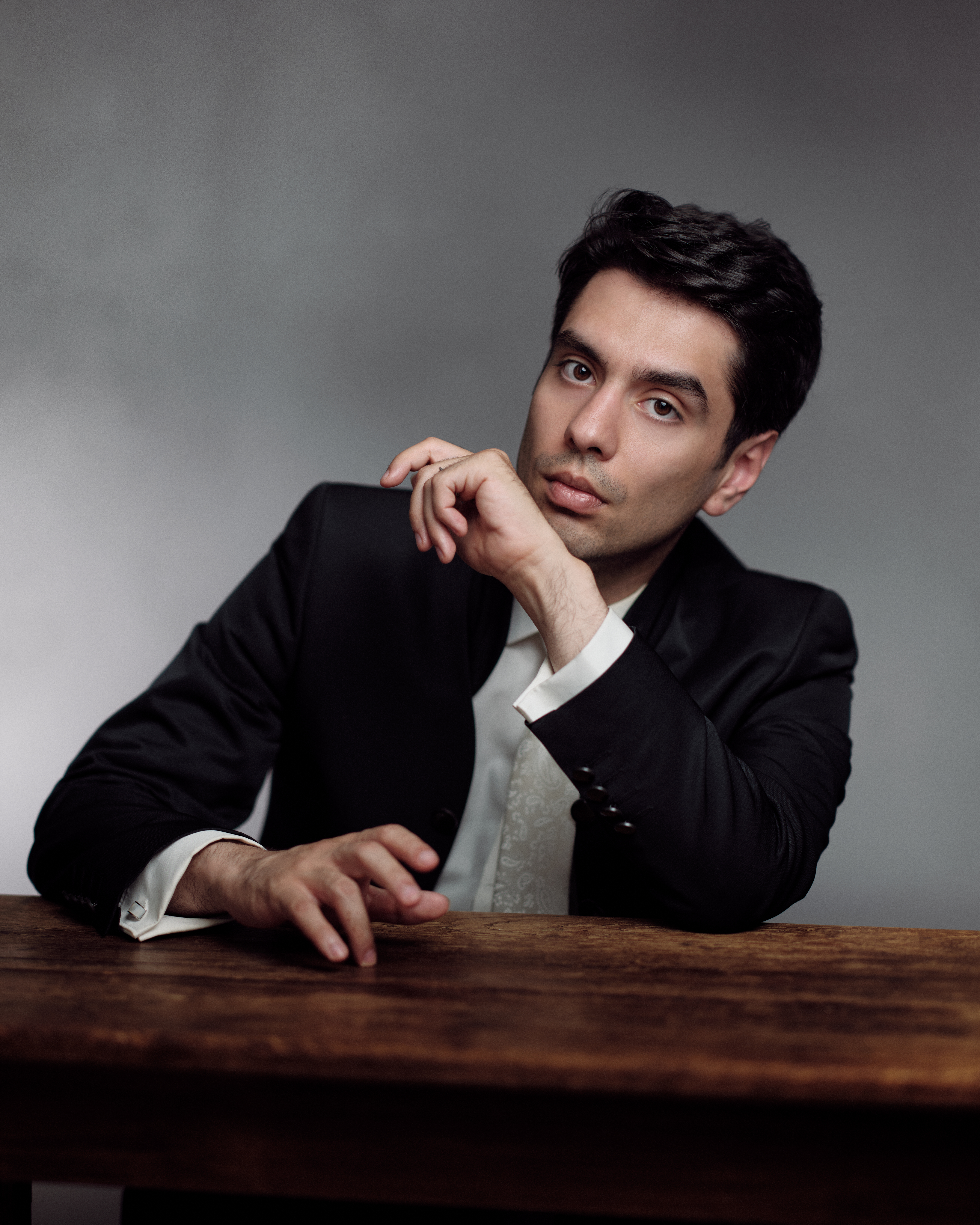
Amin Amel Ebrahimi (1997) is an Iranian - Dutch conductor and composer based in the Netherlands. He studied conducting and composition at the conservatories of Rotterdam (Codarts) and Tilburg (Fontys), where his mentors included Antony Hermus, Anthony Fiumara, Louis Buskens, Aart Strootman, Hawar Tawfiq, Sander Teepen, and Hans Leenders. He has further developed his craft in masterclasses with Johannes Schlaefli, Jac van Steen, John Adams, and Moritz Eggert. In 2023 he was awarded the prestigious MusicHub Fellowship to further his career as a conductor, composer, and artistic director.
He has worked as assistant conductor to Antony Hermus with the Danish National Symphony Orchestra, the Beethoven Orchester Bonn, and the Polish National Radio Orchestra (NOSPR), and has collaborated with the Netherlands Chamber Orchestra, Aalborg Symphony orchestra, Cappella Amsterdam, Philzuid, the Holland Festival, November Music, and Gaudeamus. Amin regularly returns to Cappella Amsterdam as guest music director. He has led the choir and the Amsterdam Andalusian Orchestra in the production of Cantigas (2023, 2026), and taken part in production of Aleppo, winner of the 2024 De Ovatie award.
Amin is the founder and artistic director of the Brabant Chamber Orchestra, a professional project-based ensemble dedicated to redefining the classical concert experience through unique programming, interdisciplinary productions, social, and cultural themes. The orchestra tours through the Netherlands with 2-5 own productions per year and appears on different festivals such as November Music.
His programming is profoundly shaped by his Eastern background: deeply connected to the post-soviet and Eastern European repertoire, and praised for his authentic and passionate interpretations, he brings lesser-known works inspired by the East together with more familiar pieces seen through fresh eyes, creating rich and distinctive concert programs.
Highlights of Amin’s current and coming season include his Danish conducting debut with the Aalborg Symphony Orchestra, and his debut with Orkest De Ereprijs with 3 productions, eight-date tour with Cappella Amsterdam, Mahler 4 at the Chassé Theater, production of Carmina Burana, and his Haunted Mansion concert tour with the Brabant Chamber Orchestra. He will also appear further as assistant conductor at Helsinki Philharmonic, Orchestre Philharmonic De Strasburg, Sinfonia Rotterdam, and Codarts Symphony Orchestra.
Amin's musical path began with his love for flamenco and Persian music as a teenager. He initially studied architecture at IAUM before committing himself fully to music and moving to the Netherlands to train as a conductor and composer. His architectural background and Persian roots continue to shape how he thinks about structure, space, and concert dramaturgy.
Amin's driving force is to understand complex ideas and make them accessible. His focus is always on relevance: does the detail support the whole, and will the form speak to the audience? As a curator, he incorporates dramaturgy, lighting, visual arts, and storytelling — crafting each concert as a fully realised experience that builds a bridge between performers and audience, and between different cultures.
[472 words] not to be altered without permission.